-

-
Guangzhou Zhongzhu Machinery Co. LtdSand casting molding machine manufacturer
-
008613926238353 WhatsApp:
-
E-mail: 470199755@qq.com
Inoculants can promote the graphitization of molten metal iron, eliminate and reduce the tendency of white casting, reduce the sensitivity of casting section, increase the number of eutectic clusters, refine the matrix structure, improve the morphology and distribution of graphite, and improve the mechanical properties of cast iron. Before pouring the sand mold, inoculating the molten metal iron has a good effect in a short period of time;
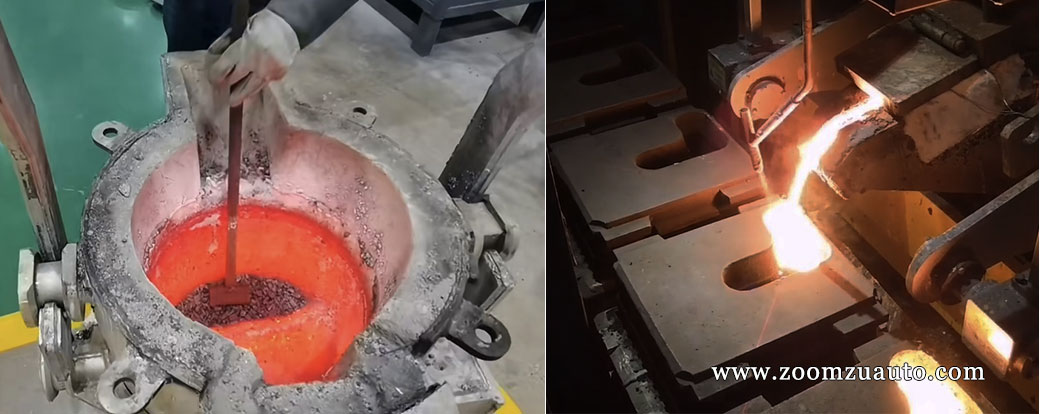
The main methods of adding inoculants include traditional casting bag inoculation and flow inoculation. Here, we refer to the instantaneous inoculation or secondary inoculation of molten metal before pouring. Traditional casting bag inoculation requires a large amount of inoculant, which can easily lead to decay and unsatisfactory inoculation effects; The method of inoculation with flow requires a small amount of inoculant, which shortens the time between the addition of inoculant and the solidification of molten iron, and can maximize the effect of inoculant because all inoculants have the highest inoculation effect when they are first added to the molten metal.
In the pouring process of the automated casting molding line, a particle size of 0.1-0.8 millimeters of inoculant is selected for flow inoculation, with a dosage of 0.8% -0.15%. The quantitative use of an automated pouring machine in conjunction with flow inoculation results in more uniform and precise addition of inoculant. Therefore, flow inoculation is widely used in gray iron (HT) and ductile iron (QT) casting, and is also an efficient and stable secondary inoculation method.